
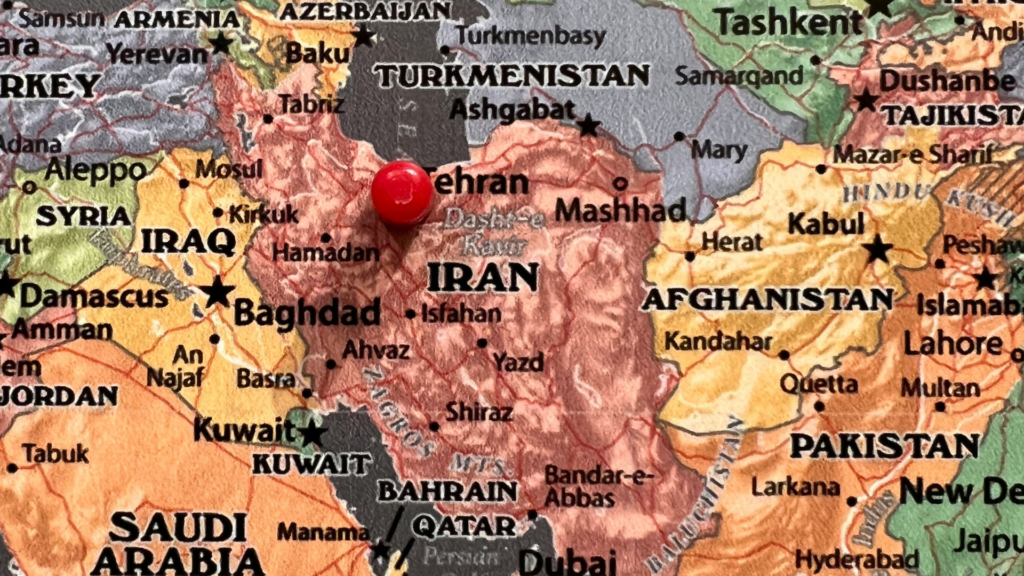
Every day it seems like we’re inching closer and closer to another World War.
The war between the US + Israel and Iran doesn’t seem to be de-escalating any time soon, despite claims of peace talks and negotiations.
As the US threatens to deploy ground troops and Iran continues to disrupt global shipping lanes and go on the offensive to disrupt the US global hedgemony, an end to the war seems nowhere in sight.
But how did we get here? What drove the US and Israel to attack Iran unprovoked? What drove Iran to bomb US bases all around West Asia? To answer these questions, we have to go back.
Back to the 1950s.
The Story
In 1951, the democratically elected Prime Minister of Iran, Mohammad Mosaddegh, made a decision about the nation’s oil resource that was antithetical to Western interests.
He decided to nationalise the Anglo-Iranian Oil Company , a British-owned company that controlled the majority of extraction, refining, and export of crude oil from Iran. This company (now known as British Petroleum) was widely considered one of the most profitable companies in the British Empire at the time.
“The petroleum industry has contributed nothing to [the] well-being of the people or to the technological progress or industrial development of my country”
Mohammad Mosaddegh at United Nations (1951)
Predictably, this caused the British government to take action, as the profits they extracted from the Iranian oil sector was vital for their post-World War Two recovery efforts.
After threatening legal action against anyone who purchased Iranian oil, the British forced the Iranian oil industry to essentially collapse, with oil production dropping almost 96% from 664,000 barrels (105,600 m3) in 1950 to 27,000 barrels (4,300 m3) in 1952.
Now, the call to nationalise a country’s own natural resource to the benefit of its own people is several degrees removed from ‘radical’, but sadly, geopolitics don’t run on logic.
In 1953, after a coup aided and abetted by intelligence agencies of the United Kingdom (MI6) and the United States (CIA), the the democratically elected Prime Minister of Iran, Mohammad Mosaddegh, was overthrown.
What came after, was disaster.
In the aftermath of the coup, as the Shah (King) of Iran, Mohammad Reza Pahlavi consolidated power and, as you would expect, did exactly what the Western powers wanted him to.
He negotiated the Consortium Agreement of 1954 with the British, which gave split ownership of Iranian oil production between Iran and Western companies (including BP) until 1979.
The Shah’s Iran: Growth without balance
Under the Shah, Iran modernised rapidly. There were land reforms, infrastructure projects, industrial expansion.
On paper, it looked like progress.
But things are rarely what they seem, especially when it comes to Western-controlled client states. Underneath the “progress”, the ‘White Revolution’ that the Shah led in 1963, and westernisation, things were breaking.
Wealth concentrated at the top.
Rural populations were displaced through land reforms.
Millions moved into cities, forming a new urban working class—with very little stability.
The Shah’s government formed a ‘secret police’ to monitor domestic dissidents with the help of U.S. and Israeli intelligence services in 1957. The Organisation of National Security and Information, Sāzmān-e Amniyyat va Ettelaʿāt-e Keshvār (SAVAK).
Opposition groups — leftists, Islamists, trade unionists — were surveilled, imprisoned, or worse.
Iran was developing. But it wasn’t stable. Or sovereign.
1979: The revolution
By the late 1970s, the pressure that built up with the Shah’s reforms reached a breaking point. Strikes, especially from oil workers, crippled the economy. Protests spread around the country. The Western-subservient system collapsed.
In 1979, the Iranian Revolution overthrew the Shah.
And just like that, Iran flipped from a pro-Western monarchy to an anti-Western Islamic Republic.
Ayatollah Khomeini took power. And one of the first things the new Iran did was ensure this would never happen again.
Enter the IRGC
The Islamic Revolutionary Guard Corps was established by Ayatollah Khomeini in 1979, with a constitutional mandate is to ensure the integrity of the Islamic Republic.
The IRGC is:
- A military force
- A political player
- And an economic empire
Through organisations like Khatam al-Anbiya, it operates across:
- Energy
- Construction
- Finance
- Transportation
It’s not just part of the state. It is the state, in many ways.
When the sanctions started hitting the country after the Iranian Revolution, the IRGC developed systems to bypass restrictions, including black market oil networks and “shadow fleets” that allowed Iran to continue exporting oil outside official channels.
If the global system tried to isolate Iran, Iran learned how to operate around it.
The Why
Iran has access to two things that the global economy cares deeply about: oil and access to one of the world’s shipping lanes, the Strait of Hormuz.
And that’s exactly why Western-aligned powers fear a powerful non-aligned actor like Iran.
Oil is never just oil
Iran holds massive energy reserves, but more importantly, it operates outside the Western-controlled energy system. It sells oil to countries like China and bypasses traditional pricing and financial mechanisms.
That threatens western hegemony and in geopolitics, that’s often a death sentence.
Sovereignty has a cost
After the revolution in 1979, Iran stopped aligning with Western interests, and that shift came with consequences.
Direct intervention like the 1953 coup became less viable, so the strategy evolved. Instead of removing the government outright, western powers (primarily the US) shifted the focus to applying sustained pressure.
This was done through sanctions and covert operations (like Stuxnet, a malicious computer worm introduced to computer systems in Iranian nuclear facilities).
Sanctions upon sanctions
Speaking of sanctions, the US immediately went to work after the revolution 1979, imposing sanctions upon sanctions on Iran to pressure the country. Over the last ~45 years, Iran has faced:
- Asset freezes (Executive Order 12170)
- Trade bans (Comprehensive Iran Sanctions, Accountability, and Divestment Act, Executive Order 13871, etc)
- Banking restrictions (SWIFT disconnection, U-turn transactions ban)
- Limits on oil exports (Executive Order 13622)
- Bans on industrial materials (‘Dual-use’ technology exports ban)
- and more…
These extensive sanctions didn’t just weaken the economy, it slowed development, created further instability in the country, and possibly caused hundreds of thousands excess civilian deaths.
All in pursuit of destabilising a sovereign nation in the interest of western hegemony.
The nuclear problem (excuse)
We’ve all heard in the news a hundred times over, “Iran is [X] amount days/weeks/months away from building a nuclear weapon”. It’s the exact same excuse the US and Israel used (and still use) to continue aggression against Iran.
But here’s the truth.
in 2015, Iran agreed to the JCPOA (Joint Comprehensive Plan of Action, aka the Iran Denuclearisation Agreement), capping their Uranium enrichment in exchange for sanctions relief. The agreement was finalised in Vienna on 14 July 2015, between Iran and the five permanent members of the United Nations Security Council (China, France, Russia, the UK, and the US) plus Germany.
By 2016, compliance with the JCPOA was verified by international verification mechanisms, and the US and the EU lifted nuclear-related sanctions.
But by 2018, the US unilaterally withdrew from the agreement, reimposing the sanctions the country had lifted mere two years ago. Iran’s efforts to renegotiate terms failed, and by 2019, the country resumed its nuclear programme.
Iran has clearly stated it has no intention of building a nuclear weapon. The country uses its weapons-grade Uranium stockpiles as leverage, but seldom has it helped them.
Larger geopolitical impacts
At a certain point, Iran stops being just a country and starts becoming a strategic asset.
For a long while now, the majority of the US’s policy decisions have revolved around getting an upper hand on China at any cost.
For the US, Iran is tied to China, supplies oil outside Western systems, and participates in emerging blocs like BRICS. Destabilising Iran doesn’t just affect one nation, it disrupts broader economic and geopolitical structures that stands in opposition the US hegemony.
From this perspective, Iran isn’t the end goal, it’s part of a larger system of competition.
So What Happens Now?
All of this leads directly to the present.
The US threatens boots-on-the-ground warfare, to occupy Kharg Island and control Iran’s oil exports, and completely destabilise the country and install a new “regime” that’s more amenable to western interests.
Iran continues attacking US and Israeli bases and infrastructure around West Asia, and invites the US to try boots-on-the-ground warfare against them.
Every discussion about Iran quickly becomes a discussion about what counts as terrorism, who gets to define legitimate violence, when sanctions are called diplomacy, when military pressure is called deterrence, and how empire survives after the formal end of empire.
What we’re seeing today is the continuation of a story that began ages ago, far before the 1950s where we began our story here. It’s a story about power, about what counts as terrorism, who gets to define legitimate violence, and how a failing empire grasps at its final straws to maintain unipolarity in an increasing multipolar world.
And until those underlying dynamics change, we’re going to keep seeing the same story play out, just with different headlines.